01 / TEACHERS
Time back for teaching
Draft questions, build papers, and organize feedback with less evening admin and more attention for students.
Atrium is Nepal’s AI-assisted learning hub, connecting teachers, students, parents, and school leaders around one trusted record of learning. AI helps teachers create, assess, and personalize learning at speed, while teachers stay in control.
Built by educators and technologists with roots in Nepal’s classrooms and experience building learning systems in the US.
Given r = 0.3 m and q₁ = q₂ = 2 μC, what is the electrostatic force?
A ball is projected at 20 m/s at 30°. What is its maximum height?
SEE Prep gives you practice papers in the SEE pattern and an AI tutor that explains the method instead of handing you the answer. Your school does not need to be on Atrium, and there is nothing to install. AI marks on written answers are estimates, shown as such.
When learning connects, the work teachers do becomes clear to the people who rely on it: students, parents, and school leaders.
Draft questions, build papers, and organize feedback with less evening admin and more attention for students.
Students see strengths, gaps, and feedback sooner, so the next step is clear before the next exam.
Graded work and progress become a trusted record of learning, not just a report-card number at term end.
Every stage of assessment has a clear owner. Atrium helps teachers prepare and assess at speed while keeping professional judgment where it belongs.
AI proposes curriculum-aligned questions and marking schemes.
The teacher vets the draft before it enters the assessment flow.
Students complete work on paper or digitally, in the school’s existing rhythm.
Objective responses can be scored; written work receives teacher-reviewed feedback.
Results become useful next steps for students, teachers, and leaders.
AI grades at speed. A teacher steps in where it matters.
Atrium turns the work of teaching into a trusted learning record for every student, parent, teacher, and school leader.
Leaders can follow assessment activity and see where support may be needed without asking teachers to maintain another spreadsheet.
At-risk means recent assessment patterns suggest a student needs timely teacher follow-up. It is a signal for support, not a label.
SIGNAL → NEXT-STEP SUPPORT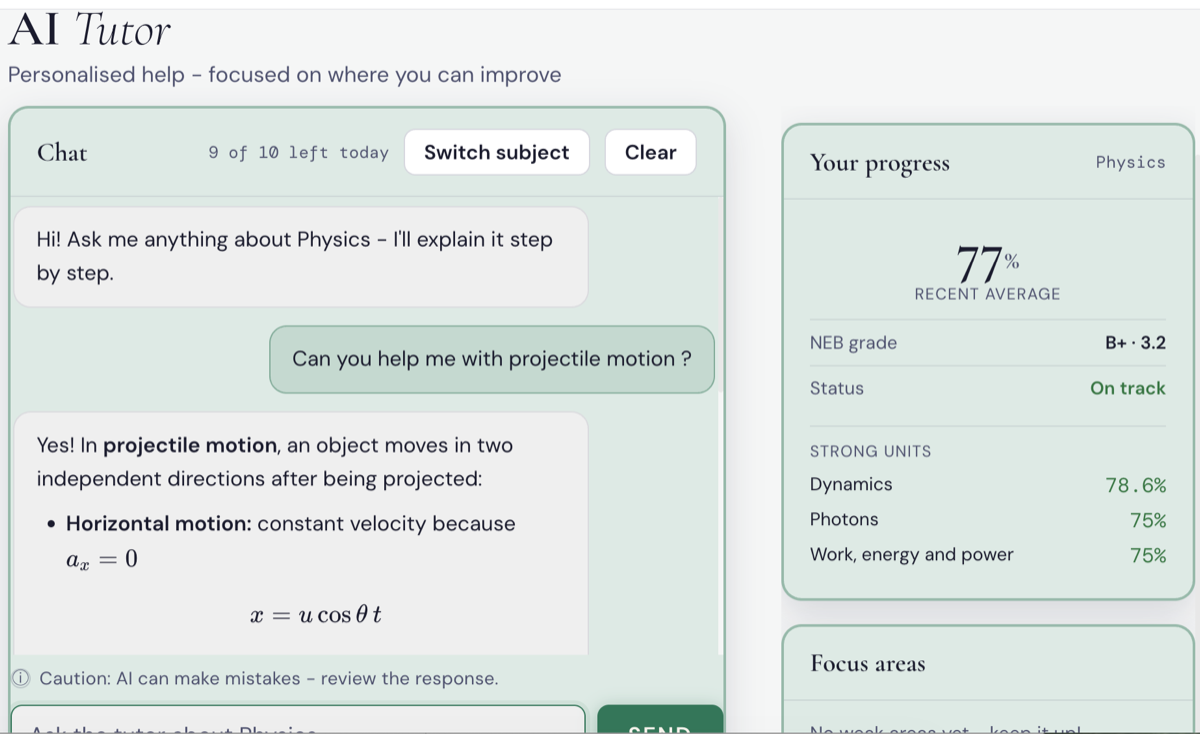
The question expects you to apply Coulomb’s law, substitute both charges and distance, and report force in newtons. The working is correct; units need a reminder.
Bring the answers needing attention to the surface first; teachers retain the final say.
Students see what they did well and where to focus next, not only a final score.
Admins can compare class-level averages over time, spot where support is needed, and follow the effect of a school-wide intervention.
Capability matters only when a school can understand and trust how it is used. Atrium’s role is to strengthen the teaching process, not bypass it.
Question proposals are built around NEB/SEE assessment context for the pilot’s subjects and grades.
AI suggestions support the workflow; teachers review assessed work and feedback.
Each school’s assessment record remains separated within its own learning environment.
If an answer pattern looks unusual, Atrium keeps the assessment and its context together for a teacher to review. It supports a fair conversation, not an automatic penalty.
We configure classes, import roster data, and train department teams. Together, we learn what strengthens adoption, feedback turnaround, teacher time, and parent visibility.
Join the founding pilot